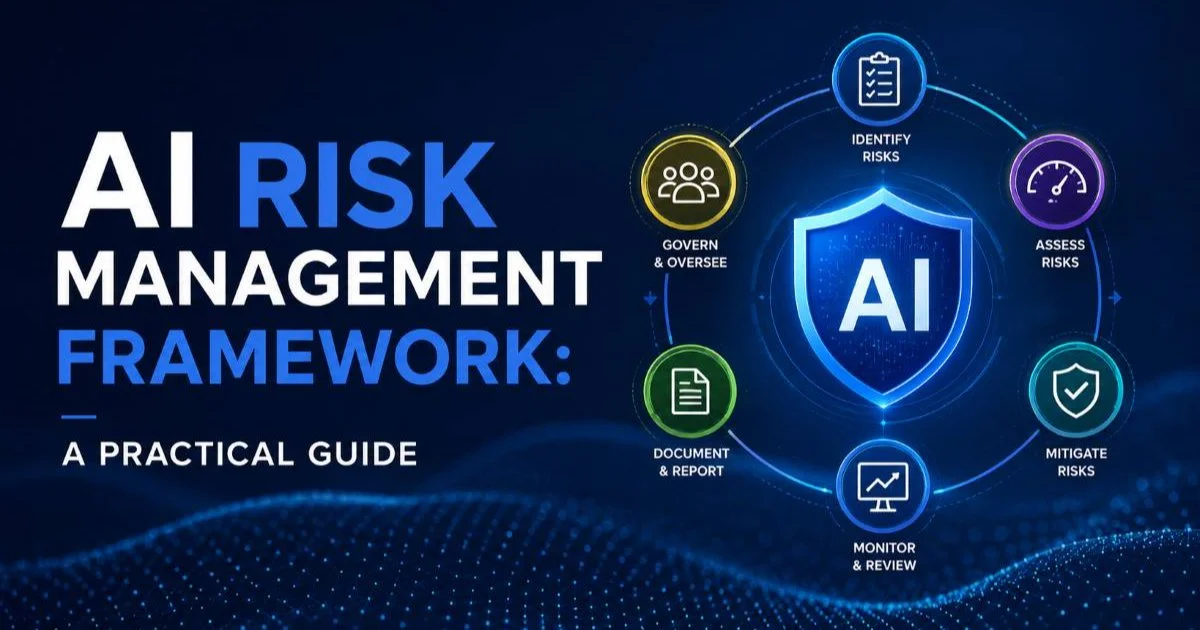
An AI risk management framework gives organizations a structured method for identifying, evaluating, and mitigating the risks that accompany artificial intelligence systems. For AI project managers and compliance officers, the absence of such a framework means operating blind in a regulatory landscape that's tightening fast.
The EU AI Act now classifies AI systems by risk tier, and the U.S. National Institute of Standards and Technology (NIST) published its own AI Risk Management Framework in January 2023. Both signal a global shift toward accountability.
Whether you're deploying a chatbot, a hiring algorithm, or a medical diagnostic tool, the stakes are real: fines under the EU AI Act can reach €35 million or 7% of global turnover. This guide walks you through four practical steps to build and maintain a working framework, with specific actions you can take starting this week.
Key Takeaways
- Map every AI system in your organization to a specific risk category before anything else.
- Use the NIST AI RMF's four core functions as your operational backbone.
- Document model decisions, training data sources, and bias testing results continuously.
- Assign clear ownership of risk management tasks to named individuals, not departments.
- Review and update your framework quarterly as regulations and AI capabilities evolve.
Step 1: Inventory and Classify Your AI Systems
Building Your AI System Register
You cannot manage risks you haven't identified. The first action is creating a comprehensive register of every AI system your organization uses, develops, or procures. This includes third-party tools embedded in SaaS platforms that your teams may not even recognize as AI. A 2024 Stanford HAI report found that 55% of organizations lacked a complete inventory of their AI deployments. Start by surveying department heads, reviewing procurement contracts, and auditing software licenses to surface hidden AI components.
For each system, record its purpose, the data it processes, who owns it, and which decisions it influences. Include vendor-supplied models alongside internally built ones. If your marketing team uses an AI-powered content tool and your HR department screens resumes with an algorithm, both belong in the register. Understanding what AI compliance actually requires starts with knowing exactly what you're working with. Without this baseline, every subsequent step rests on incomplete information.
Assigning Risk Tiers
Once your inventory exists, classify each system by risk level. The EU AI Act provides a useful four-tier model: unacceptable, high, limited, and minimal risk. A social scoring system falls into unacceptable. A hiring algorithm or credit scoring model qualifies as high risk. A chatbot with disclosure requirements sits at limited risk. Spam filters and recommendation engines typically fall into minimal risk. Your classification directly determines which compliance obligations apply.
| Risk Tier | Example AI Systems | Key Obligations | Penalty Exposure |
|---|---|---|---|
| Unacceptable | Social scoring, manipulative AI | Prohibited entirely | Up to €35M or 7% turnover |
| High | Hiring tools, credit scoring, medical diagnostics | Conformity assessment, documentation, human oversight | Up to €15M or 3% turnover |
| Limited | Chatbots, deepfake generators | Transparency and disclosure obligations | Up to €7.5M or 1.5% turnover |
| Minimal | Spam filters, game AI | Voluntary codes of conduct | Minimal regulatory risk |
Tag each AI system in your register with its risk tier immediately. This single label drives every downstream compliance decision.
Step 2: Adopt a Structured AI Risk Management Framework
The NIST AI RMF Core Functions
Rather than building from scratch, adopt an established AI risk management framework as your foundation. The NIST AI RMF (AI 100-1) organizes risk management into four core functions: Govern, Map, Measure, and Manage. Govern establishes the policies and roles. Map identifies context and surfaces risks. Measure uses quantitative and qualitative methods to analyze those risks. Manage applies specific treatments, from mitigation to acceptance. This structure gives your team a shared vocabulary and repeatable process that auditors and regulators recognize.
"A framework without assigned ownership is just a document; a framework with named accountable individuals becomes a management system."
Start with the Govern function. Establish an AI governance committee that includes representatives from legal, engineering, product, and risk management. Define escalation paths for when a risk assessment reveals a high-severity finding. Write down who has authority to approve, pause, or terminate an AI deployment. The NIST framework explicitly calls for organizational commitment at the leadership level. Without executive sponsorship, compliance efforts stall when they conflict with product timelines. For deeper guidance on governance structures, the practices outlined at VisionVix's AI governance guide offer a solid reference.
Aligning with EU AI Act Requirements
If your products or services touch EU citizens, you must align your framework with the EU AI Act's specific requirements. High-risk systems need a conformity assessment before deployment, ongoing monitoring, and detailed technical documentation. The Act also mandates a quality management system covering data governance, testing procedures, and post-market surveillance. Map each EU AI Act requirement to a specific control in your framework so nothing falls through the cracks. The regulation's phased enforcement, which began in February 2025 with prohibitions on unacceptable risk AI, means your timeline for compliance is already running.
The EU AI Act's high-risk system obligations apply to both providers and deployers. If you use a third-party AI tool classified as high-risk, you have compliance duties too.
Cross-referencing your framework with multiple standards adds resilience. ISO/IEC 42001, the international standard for AI management systems published in 2023, provides another complementary structure. Organizations already certified under ISO 27001 for information security will find familiar patterns. The goal is not to follow one framework rigidly but to build a comprehensive risk management approach that satisfies multiple regulatory regimes simultaneously. This matters especially for companies operating across jurisdictions where requirements differ in specifics but converge on principles like transparency, accountability, and human oversight.
Step 3: Implement Risk Controls and Documentation
Technical Controls
With your framework selected and risk tiers assigned, implement concrete technical controls for each AI system. For high-risk systems, this means bias testing across protected demographic groups before deployment, with results documented and retained. Use fairness metrics like demographic parity, equalized odds, and calibration. Run adversarial testing to probe for manipulation vulnerabilities. Establish performance baselines for accuracy, precision, recall, and F1 scores, then set drift thresholds that trigger automatic alerts when the model's behavior shifts beyond acceptable bounds.
Code-level auditing matters as much as model-level testing. Review the software dependencies, open-source libraries, and licensing terms embedded in your AI systems. A single GPL-licensed component in a proprietary model can create unexpected legal exposure. Tools designed for code auditing and license risk detection can automate much of this discovery. Technical controls should also include access controls on training data, version control for model iterations, and encrypted storage for sensitive datasets used during development.
Documentation Requirements
Documentation is where many organizations fail, not because they lack controls, but because they don't record them systematically. For each high-risk AI system, maintain a technical file that includes the system's intended purpose, training data provenance, model architecture choices and why alternatives were rejected, test results for bias and accuracy, and the human oversight mechanisms in place. The EU AI Act's Article 11 specifies these documentation requirements in detail. Treat documentation as a living artifact, updated with every material change to the model or its operating environment.
Documentation must cover the entire AI lifecycle, from initial design through deployment and decommissioning. Gaps in any phase create audit vulnerabilities.
Create templates your engineering teams will actually use. A five-page form that no one fills out is worse than a one-page checklist that gets completed every sprint. Include fields for data lineage, feature importance rankings, known limitations, and deployment conditions. Store everything in a centralized repository with access controls and audit trails. When a regulator or internal auditor requests evidence of your AI risk management framework in action, you need to produce it within days, not weeks.
Step 4: Monitor, Review, and Iterate
Continuous Monitoring Practices
Deploying an AI system without ongoing monitoring is like launching a satellite and throwing away the telemetry. Set up automated pipelines that track model performance metrics in production. Monitor input data distributions for concept drift, where the real-world data starts diverging from the training data. Flag anomalies in prediction confidence scores. Schedule quarterly model revalidation for high-risk systems and annual reviews for lower-tier ones. The NIST framework's Measure function provides specific guidance on selecting appropriate metrics for different risk contexts.
Post-market surveillance, a term borrowed from medical device regulation, applies directly to AI under the EU AI Act. For high-risk systems, you must collect and analyze data on the AI system's performance throughout its lifecycle. This includes monitoring user complaints, tracking incidents where the system produced unexpected outputs, and testing for emergent biases that may appear as the user population shifts. Build feedback loops that route frontline user observations back to your data science and risk management teams.
Governance and Accountability
Your AI governance committee should meet monthly, with a standing agenda that reviews new risk findings, regulatory updates, and incident reports. Assign a named AI risk owner to each high-risk system, someone who is accountable for that system's compliance posture and who reports directly to the committee. This is not a part-time role for a senior engineer. Organizations that embed risk ownership into job descriptions and performance evaluations see meaningfully better compliance outcomes than those that treat it as an afterthought layered on top of existing responsibilities.
Regulatory change management deserves its own process. The AI regulatory landscape is shifting across every major jurisdiction. Subscribe to regulatory feeds, participate in industry working groups, and maintain a change log that maps new requirements to your existing controls. When the EU AI Act's high-risk provisions take full effect in August 2026, your framework should already reflect those requirements. Quarterly framework reviews should ask three questions: What has changed in our AI portfolio? What has changed in the regulatory environment? And are our current controls still sufficient? If the answer to the third question is ever uncertain, that itself is a finding that requires action.
Set calendar reminders for key regulatory deadlines. For the EU AI Act, mark August 2025 for governance rules and August 2026 for high-risk system obligations.
Frequently Asked Questions
?How do I build an AI system register if AI tools are hidden in SaaS?
?Does the NIST AI RMF satisfy EU AI Act compliance requirements?
?How long does it realistically take to build a working AI risk framework?
?Is assigning risk ownership to departments instead of individuals a real problem?
Final Thoughts
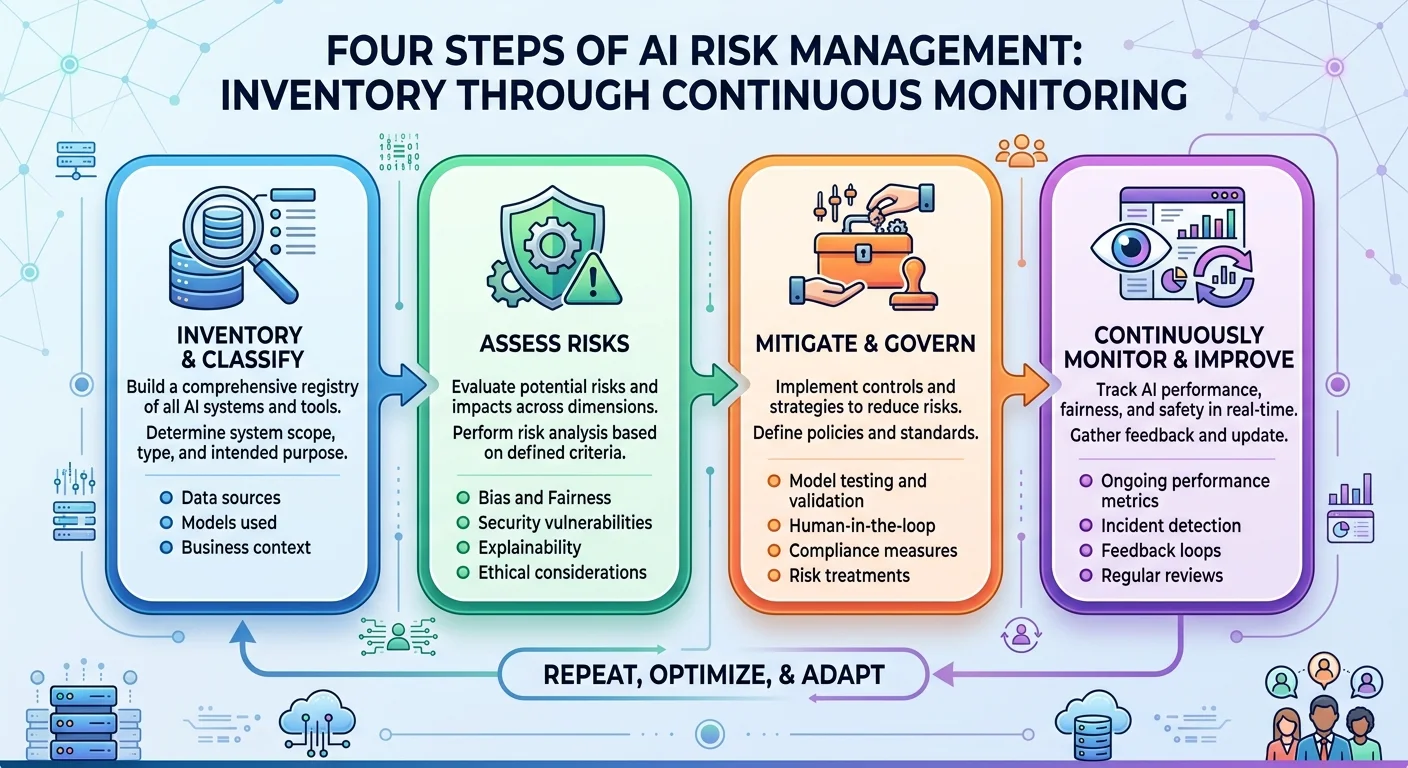
Building an AI risk management framework is not a one-time project; it is an ongoing operational commitment. The four steps outlined here, inventory and classification, framework adoption, control implementation, and continuous monitoring, provide a repeatable structure that scales with your AI portfolio.
Start with your highest-risk systems and expand outward. Assign real ownership, maintain honest documentation, and treat regulatory compliance as a floor rather than a ceiling. The organizations that get this right won't just avoid fines; they'll build AI systems that their customers, regulators, and employees actually trust.
Disclaimer: Portions of this content may have been generated using AI tools to enhance clarity and brevity. While reviewed by a human, independent verification is encouraged.