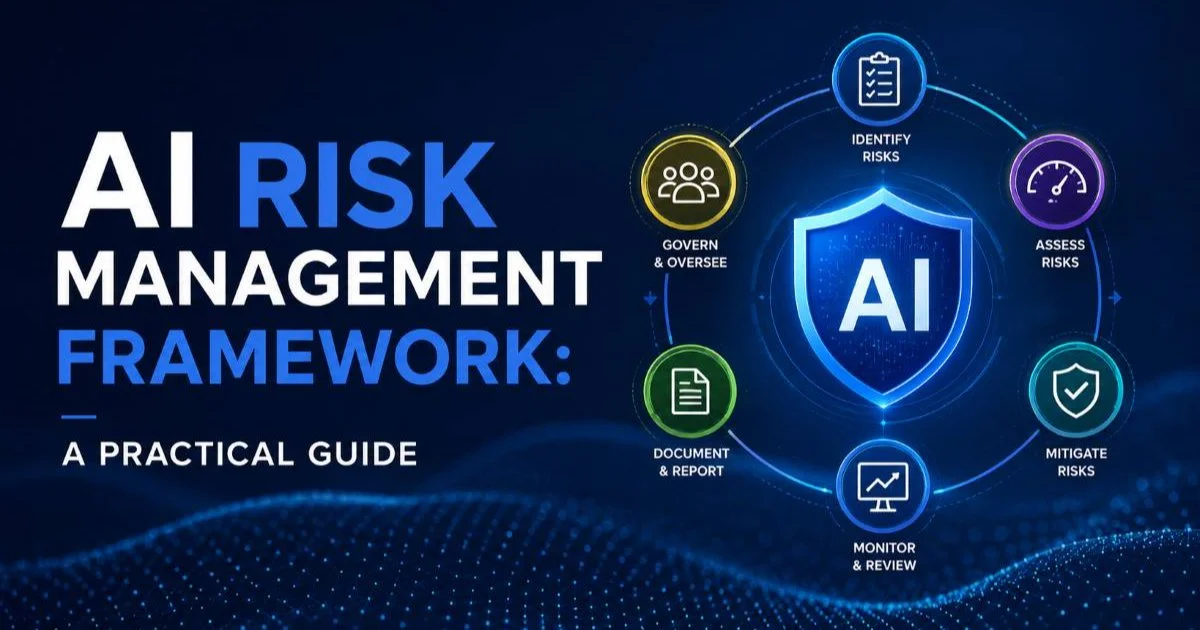
AI governance best practices have moved from boardroom buzzwords to operational necessities for enterprises deploying machine learning systems at scale. As regulations tighten globally and public scrutiny intensifies, AI project managers and compliance officers face mounting pressure to build governance structures that actually work.
The stakes are real: fines under the EU AI Act can reach €35 million or 7% of global revenue, and reputational damage from a biased algorithm can erode years of brand trust overnight. Getting governance right means balancing innovation speed with accountability, transparency, and risk control.
Understanding what AI compliance actually means and how it works is the essential starting point. This guide walks you through four concrete steps to build a governance program that satisfies regulators, protects your users, and still lets your teams ship products.
Key Takeaways
- Map every AI system to a risk tier before writing your first governance policy.
- Assign clear ownership for each AI model's lifecycle, from development through retirement.
- Build documentation habits early; retroactive compliance is expensive and error-prone.
- Conduct regular algorithmic audits, not just at launch but on a recurring schedule.
- Align your governance framework with the EU AI Act's requirements before enforcement begins.
Step 1: Classify AI Systems by Risk
Every enterprise governance program starts with knowing what you have and how dangerous it could be if it fails. You cannot govern what you have not inventoried. Start by creating a central register of all AI and machine learning systems operating across your organization, including those built by third-party vendors. This inventory should capture the system's purpose, the data it processes, who it affects, and where it is deployed geographically.
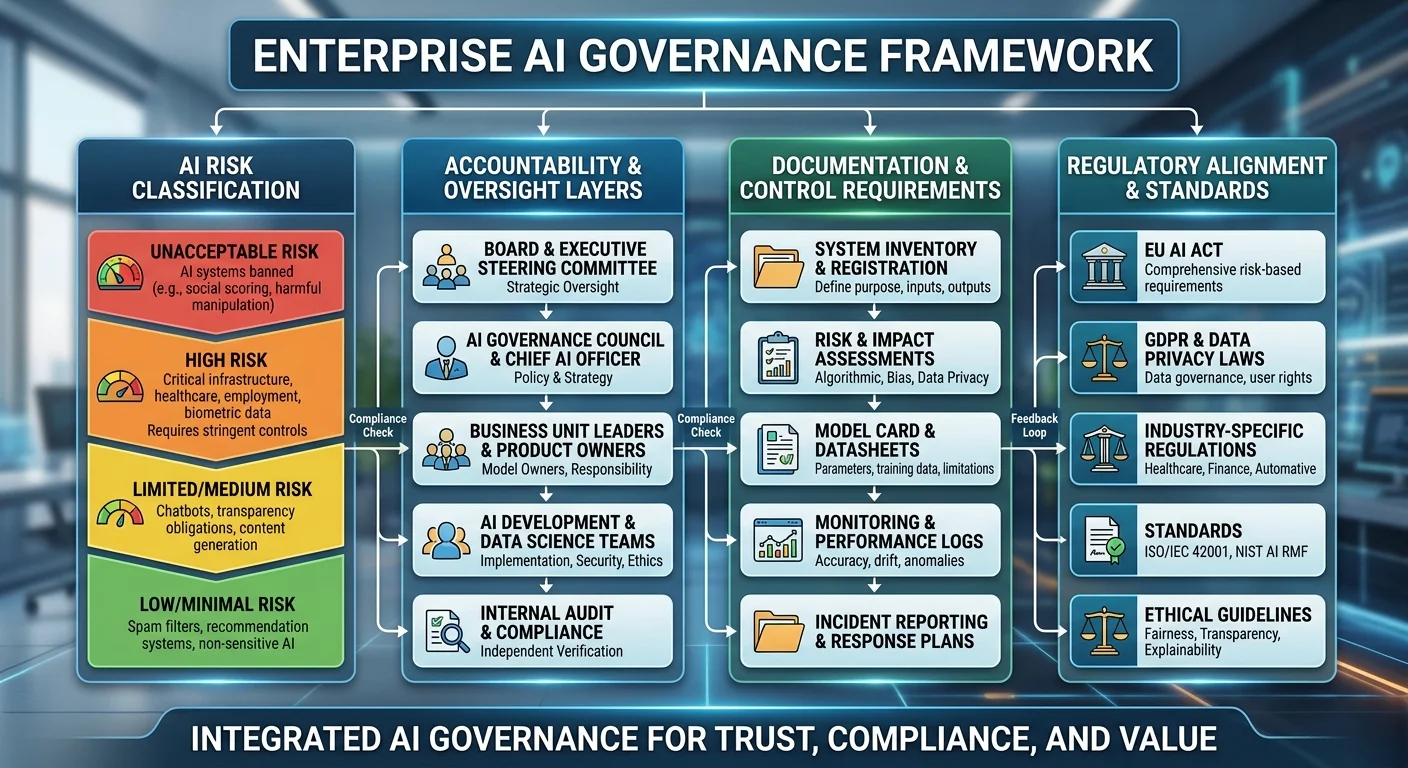
Once you have a complete inventory, assign each system a risk tier. The EU AI Act provides a useful four-tier model: unacceptable risk, high risk, limited risk, and minimal risk. A customer service chatbot answering FAQ questions sits at minimal risk. A hiring algorithm that screens resumes lands squarely in the high-risk category. Your AI risk management framework should define clear criteria for each tier so classification decisions are consistent and defensible across business units.
Building Your Risk Taxonomy
Risk classification is not a one-time exercise. New models get deployed, existing ones get retrained on fresh data, and regulatory definitions evolve. Build a quarterly review cycle where system owners must reconfirm or update their risk classification. Include triggers for automatic reclassification, such as expanding a model's use to a new geographic market or a new demographic group. Document every classification decision with a brief rationale so auditors can trace your reasoning.
| AI System Type | Risk Tier | Key Concern | Governance Action Required |
|---|---|---|---|
| Social scoring systems | Unacceptable | Fundamental rights | Prohibit deployment |
| Hiring/recruitment AI | High | Discrimination | Full audit, impact assessment |
| Credit scoring models | High | Financial harm | Bias testing, explainability |
| Customer chatbots | Limited | Transparency | Disclosure of AI use |
| Spam filters | Minimal | Low impact | Standard monitoring |
Use a shared spreadsheet or governance tool to maintain your AI system inventory; it forces cross-team visibility and prevents shadow AI deployments from flying under the radar.
Step 2: Establish Roles, Accountability, and Oversight
Governance without clear ownership is just paperwork. The single most common failure in enterprise AI governance is diffusion of responsibility, where data scientists assume legal handles compliance and legal assumes engineering handles bias testing, and nobody does either. Assign a named individual as the accountable owner for each high-risk AI system. This person does not need to write every line of code, but they must sign off on deployment decisions and answer for the system's behavior.
Beyond individual system owners, establish a cross-functional AI governance committee. This group should include representatives from engineering, legal, compliance, product management, and ethics (if you have a dedicated function). The committee meets monthly to review new deployment proposals, examine incident reports, and update governance policies. Microsoft's Responsible AI program and Google's AI Principles review process both follow this model, with executive sponsors providing budget authority and escalation paths.
"Governance without clear ownership is just paperwork that gathers dust in a shared drive."
The Governance Committee Structure
Your governance committee needs decision-making authority, not just advisory power. Give them the ability to block or pause a deployment if risk assessments are incomplete. Define escalation procedures for disagreements between the committee and product teams. When a product manager pushes back on a delay, the committee should have a documented escalation path to a C-level sponsor. Effective AI governance structures balance speed with safety by establishing pre-approved fast tracks for minimal-risk systems and deeper review gates for high-risk ones.
Training is another critical accountability layer. Every team member involved in building or deploying AI should complete annual training on your organization's AI governance best practices, relevant regulations, and bias awareness. Track completion rates as a compliance metric. If an engineer deploying a credit scoring model has not completed bias training, that is a red flag your governance program should catch before deployment, not after an incident.
Advisory-only governance committees tend to get ignored when deadlines are tight. Give your committee actual authority to hold or reject deployments.
Step 3: Implement Documentation and Audit Processes
Documentation is where AI governance best practices meet the real world. Regulators do not care about your intentions; they care about your records. The EU AI Act requires detailed technical documentation for high-risk systems, including training data descriptions, model architecture, performance metrics, and testing results. If you cannot produce these records on request, you will fail a regulatory audit regardless of how well your model actually performs. Start building documentation habits from day one of model development, not as a retroactive cleanup project.
Create standardized templates for model cards, data sheets, and impact assessments. Model cards (a concept popularized by Google's research team in 2019) summarize a model's intended use, performance benchmarks across demographic groups, and known limitations. Data sheets describe training data provenance, collection methods, and preprocessing steps. Impact assessments evaluate the potential harms a system could cause and document your mitigation strategies. Building an AI compliance program from scratch becomes far easier when these templates are in place from the start.
What to Document for Every Model
Beyond templates, establish an audit cadence. High-risk systems should undergo independent algorithmic audits at least annually, with additional audits triggered by significant model updates or data drift. Audits should test for accuracy degradation, bias amplification, and compliance with the system's original stated purpose. Internal audit teams can handle routine reviews, but consider engaging external auditors for your highest-risk systems. External audits carry more credibility with regulators and provide a fresh perspective your internal team might miss.
Version control for models and datasets is just as important as version control for source code. When a regulator asks why your model produced a specific decision in March 2024, you need to reproduce that exact model state. Track model versions, training data snapshots, hyperparameters, and deployment configurations in a centralized system. Using quality documentation practices for your internal records and audit trails pays dividends when regulators come knocking or when you need to debug a production issue under time pressure.
Do not rely on data scientists to self-document. Integrate documentation requirements into your CI/CD pipeline and code review process so models cannot be deployed without completed records.
Step 4: Align with Regulations and Iterate
AI governance does not exist in a vacuum. Your internal framework must map to the external regulatory landscape, and that landscape is shifting rapidly. The EU AI Act entered into force in August 2024, with enforcement phasing in through 2027. Canada's AIDA, Brazil's AI regulatory framework, and various U.S. state-level laws add layers of complexity for multinational enterprises. A thorough understanding of AI regulations by country helps you identify which requirements apply to your specific deployments and where gaps exist in your current program.
Map each regulatory requirement to a specific control in your governance framework. If the EU AI Act requires conformity assessments for high-risk systems, document exactly which internal process satisfies that requirement, who performs it, and where the evidence lives. This mapping exercise often reveals overlaps (reducing duplicate work) and gaps (highlighting areas needing new processes). Treat the mapping as a living document that gets updated as regulations evolve. Assign a compliance officer or small team to monitor regulatory developments monthly.
Tracking Regulatory Changes
Subscribe to regulatory update feeds from bodies like the European AI Office, NIST, and relevant national authorities. Join industry working groups where draft guidance gets discussed before publication. Being proactive about regulatory intelligence gives your organization months of lead time to adapt, rather than scrambling after a new rule takes effect. AI governance best practices emphasize continuous improvement: treat each regulatory update as an opportunity to strengthen your program, not just a compliance burden to tolerate.
Finally, measure and report on your governance program's effectiveness. Track metrics like audit completion rates, documentation coverage, incident response times, and employee training completion. Report these to your board or executive leadership quarterly. Governance programs that lack visibility at the executive level tend to atrophy over time. By demonstrating measurable progress, clear risk reduction, and regulatory readiness, you build the organizational support needed to sustain your governance investment for the long term.
Create a regulatory change log that tracks every new AI regulation or guidance document, its effective date, which of your systems it affects, and what action you have taken in response.
Frequently Asked Questions
?How often should we rerun risk classification for existing AI models?
?Does the EU AI Act's four-tier model work for non-EU enterprises?
?How expensive is retroactive compliance compared to building it in early?
?Is a usage policy enough if we already have AI in production?
Final Thoughts
Building effective AI governance best practices requires systematic effort across risk classification, accountability, documentation, and regulatory alignment. No single policy or tool solves the problem; it takes a coordinated program with executive backing and operational discipline. Start with your highest-risk systems, get the fundamentals right, and expand from there.
The enterprises that treat governance as a competitive advantage rather than a cost center will be the ones best positioned for the regulatory landscape ahead. Begin today, because retrofitting governance onto mature AI systems is always harder than building it in from the start.
Disclaimer: Portions of this content may have been generated using AI tools to enhance clarity and brevity. While reviewed by a human, independent verification is encouraged.