Learning how to build an AI compliance program from scratch is one of the most pressing challenges facing organizations today. With the EU AI Act entering enforcement, new state-level regulations emerging in the U.S., and growing public scrutiny of automated decision-making, the window for voluntary preparation is closing fast.
For AI project managers and compliance officers, the stakes are real: fines under the EU AI Act can reach €35 million or 7% of global revenue, whichever is higher. But compliance isn't just about avoiding penalties.
A well-structured program protects users, builds trust with stakeholders, and positions your organization as a responsible AI deployer. If you're starting with nothing more than a mandate and good intentions, this guide walks you through the process step by step.
Key Takeaways
- Start by mapping every AI system your organization currently develops, deploys, or procures.
- Classify each system by risk level before writing a single compliance policy.
- Assign clear ownership of AI compliance to specific roles, not committees alone.
- Build documentation habits early because retrofitting records is expensive and unreliable.
- Treat your compliance program as a living system that evolves with new regulations.

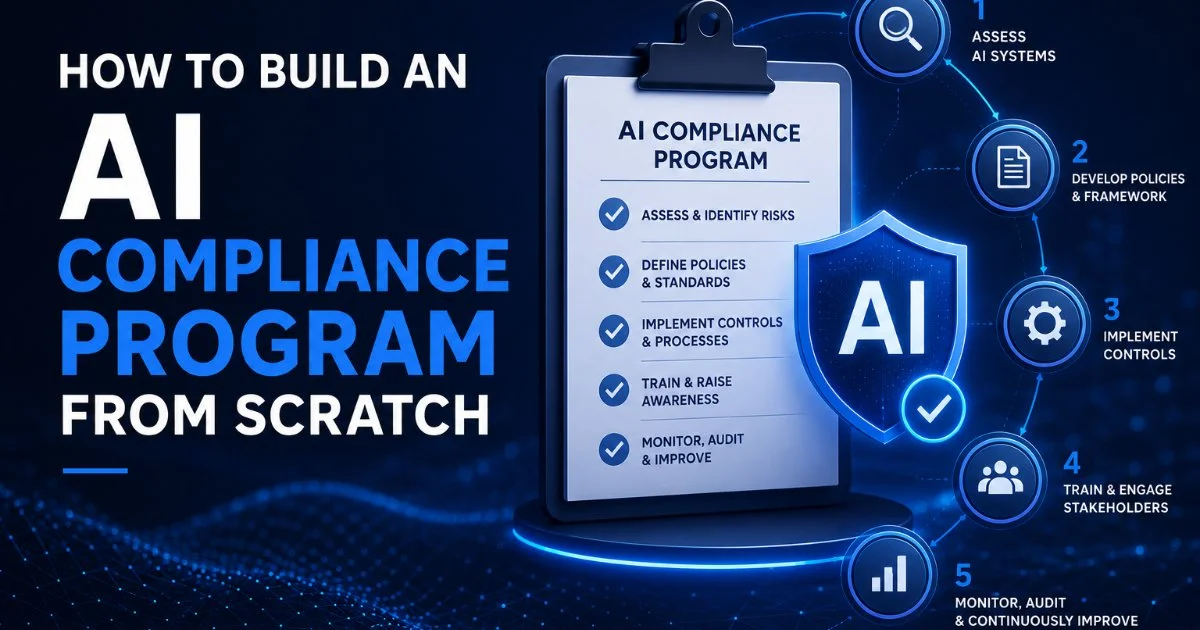
Step 1: Inventory and Risk Classification
Conducting Your AI Inventory
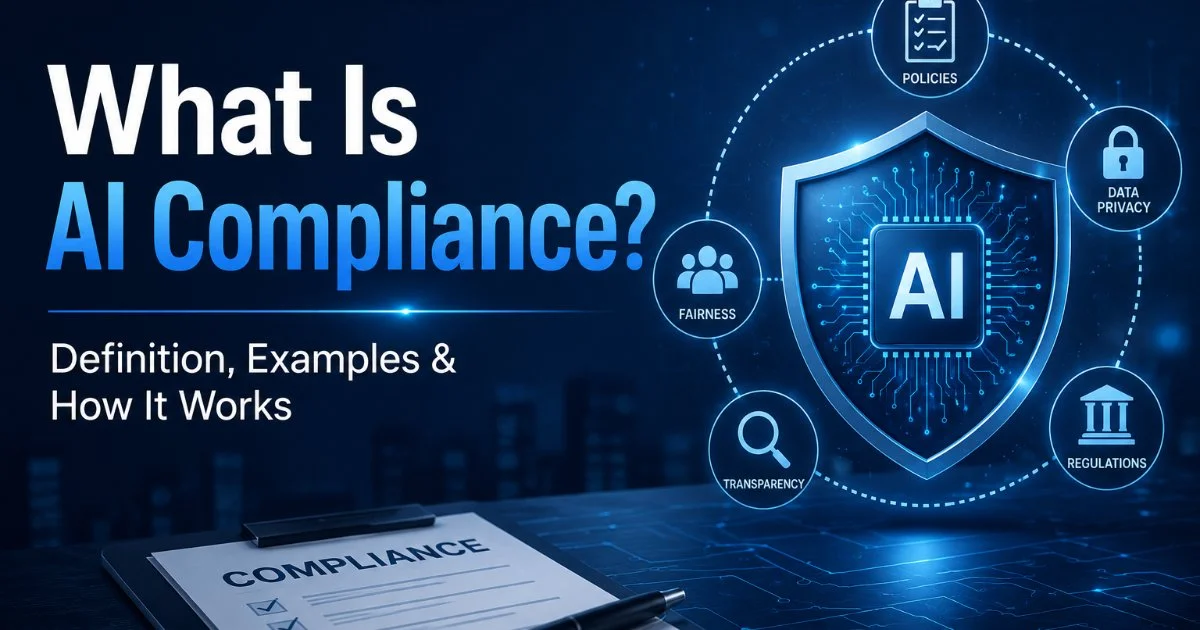
You cannot govern what you cannot see. The first step in building any AI compliance program is creating a comprehensive inventory of every AI system your organization touches. This includes systems you've built in-house, third-party tools embedded in your workflows, and AI features hidden inside SaaS platforms you already use. If you need a foundational understanding of what compliance means in this context, our guide on what AI compliance is, with definitions and examples, provides essential background.
For each system, record its purpose, the data it processes, who uses it, and what decisions it influences. Many organizations are surprised to find they have dozens of AI-powered tools scattered across departments, from HR screening software to customer service chatbots to predictive analytics in finance. A procurement review often reveals AI capabilities that nobody in compliance knew existed. Be thorough here, because gaps in your inventory will become blind spots in your program.
Send a structured survey to every department head asking them to list any tools that automate decisions, generate predictions, or process personal data using machine learning.
Classifying Risk Levels
Once your inventory is complete, classify each system by risk level. The EU AI Act provides a clear framework with four tiers: unacceptable, high, limited, and minimal risk. High-risk systems (think biometric identification, credit scoring, and employment screening) carry the heaviest compliance obligations. Even if your organization operates outside the EU, this classification model serves as an excellent starting point because many emerging regulations globally follow similar logic. Our overview of AI regulations by country shows just how widespread this tiered approach has become.
At the end of this step, you should have a complete spreadsheet or database listing every AI system, its risk classification, the regulatory regimes that apply to it, and the business owner responsible for it. This inventory becomes the backbone of everything that follows.
| Risk Level | Examples | Key Obligations | Documentation Required |
|---|---|---|---|
| Unacceptable | Social scoring, manipulative AI | Prohibited entirely | N/A (must discontinue) |
| High | Biometric ID, credit scoring, hiring tools | Conformity assessment, human oversight, transparency | Full technical documentation, risk assessment, data governance records |
| Limited | Chatbots, emotion recognition | Transparency obligations | User disclosure records, interaction logs |
| Minimal | Spam filters, game AI, recommendation engines | Voluntary codes of conduct | Basic system description recommended |
Step 2: Establish Governance Structure and Ownership
Defining Roles and Responsibilities
A compliance program without clear ownership is a program that stalls. You need to designate specific individuals, not just committees, who are accountable for AI governance outcomes. At a minimum, appoint an AI Compliance Lead who reports to senior leadership and has authority to halt deployments that fail compliance checks. This person should understand both the regulatory landscape and the technical realities of your AI systems. For a deeper look at structuring these roles, the guide on AI governance best practices for enterprises offers practical frameworks.
Below the lead, designate system-level owners for each high-risk AI application. These owners are responsible for maintaining documentation, coordinating with data protection officers, and flagging changes that might alter a system's risk profile. Many organizations make the mistake of treating AI compliance as a purely legal function. In practice, it requires tight collaboration between engineering, legal, product, and operations teams.
Avoid creating an AI ethics board with no enforcement power. Advisory committees are useful, but someone with operational authority must own compliance decisions.
Building Cross-Functional Alignment
Cross-functional alignment starts with education. Run training sessions that explain AI regulations in plain language, tailored to each department's role. Engineers need to understand documentation requirements and bias testing mandates. Product managers need to know which use cases trigger high-risk classification. Legal teams need visibility into model architectures and training data sources. When everyone understands the "why" behind compliance requirements, resistance drops significantly.
Consider establishing a regular cadence of cross-functional review meetings, perhaps monthly for organizations with many AI systems, quarterly for smaller deployments. These meetings should review new deployments, assess changes to existing systems, and track regulatory developments. At the end of this step, you should have an organizational chart showing compliance roles, a RACI matrix for key compliance activities, and a training schedule for the next 12 months.
"The organizations that build compliance into their AI development lifecycle from day one spend roughly 40% less on remediation than those that retrofit it later."
Step 3: Develop Policies, Documentation, and Controls
Writing Your Core Policies
Policies translate your governance structure into actionable rules. At a minimum, your AI compliance program needs policies covering: acceptable use of AI, data governance for AI training and inference, bias testing and fairness requirements, transparency and disclosure obligations, and incident response for AI failures. Each policy should be specific enough to guide real decisions. A policy that says "we will use AI responsibly" is useless. A policy that says "all high-risk AI systems must undergo bias audits using disaggregated performance metrics before deployment" gives teams something to work with.
Documentation is where many programs fall apart. The EU AI Act mandates extensive technical documentation for high-risk systems, including descriptions of intended purpose, system architecture, training data characteristics, performance metrics, and human oversight mechanisms. Start building these records from the earliest stages of development. If you're selecting foundation models or large language models for your AI applications, resources like guides on choosing the best LLMs can inform both technical and compliance decisions simultaneously.
Create templates for each documentation type so teams don't have to reinvent the format for every system. Standardization accelerates compliance without sacrificing thoroughness.
Implementing Technical Controls
Technical controls bring your policies to life in code and infrastructure. Implement automated logging for AI system inputs, outputs, and decision rationale. Set up model monitoring dashboards that track performance drift, fairness metrics, and anomaly rates in production. Build approval gates into your CI/CD pipeline so that models cannot be deployed without passing predefined compliance checks. These aren't optional extras; they are the mechanisms that make compliance verifiable.
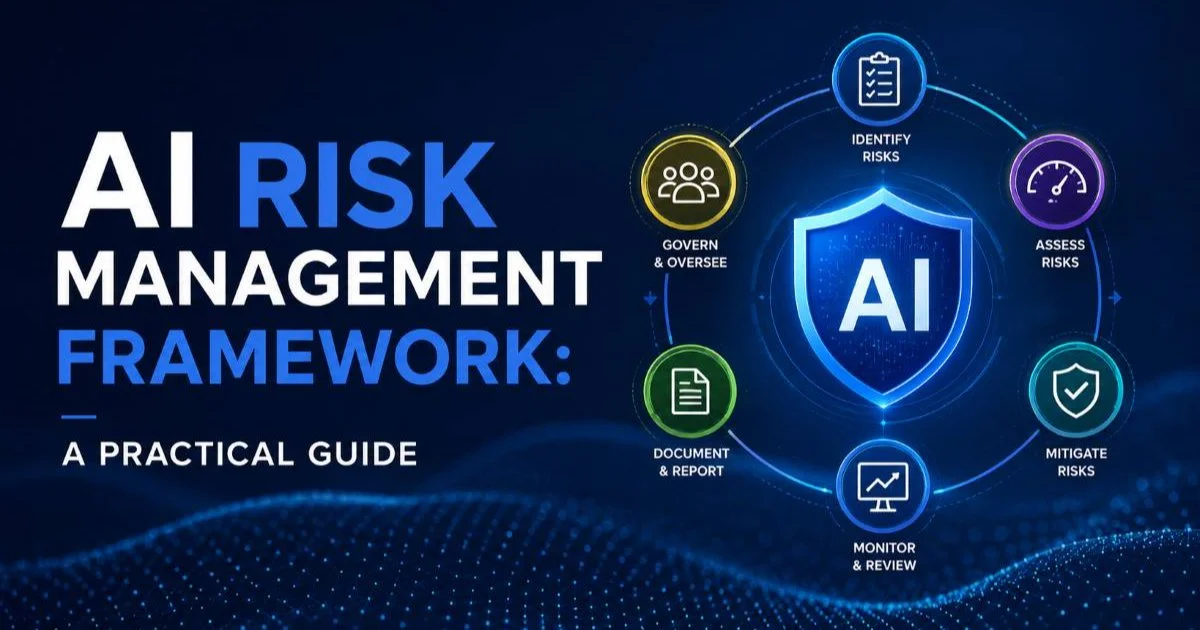
The AI risk management framework guide provides detailed approaches for integrating risk controls into your technical workflows. At the end of this step, you should have a policy library approved by leadership, documentation templates populated for all high-risk systems, and at least basic technical monitoring in place. Your team should be able to show an auditor exactly how each high-risk system works, what data it uses, and what safeguards are active.
Step 4: Monitor, Audit, and Iterate
Continuous Monitoring Practices
Understanding how to build an AI compliance program from scratch means accepting that the program is never truly "done." AI systems change over time. Models drift as real-world data diverges from training distributions. Regulations evolve; the EU AI Act itself has phased implementation dates stretching into 2027. New use cases emerge that push existing systems into higher risk categories. Your compliance program must account for all of this through continuous monitoring.
Set up automated alerts for performance degradation, fairness metric violations, and data quality issues. Establish thresholds that trigger human review. For example, if a hiring model's selection rate ratio between demographic groups drops below 0.8 (the four-fifths rule commonly used in employment law), that should automatically flag a compliance review. Monitor your regulatory environment too; assign someone to track proposed legislation in every jurisdiction where you operate.
Model performance can degrade gradually without triggering obvious errors. Quarterly statistical reviews catch drift that real-time monitoring might miss.
Audit Cycles and Program Updates
Schedule formal audits at least annually for high-risk systems and biennially for lower-risk ones. Internal audits should verify that documentation is current, that bias testing has been conducted on schedule, and that technical controls are functioning as intended. Consider engaging external auditors for your highest-risk systems; third-party validation carries significant weight with regulators and builds public trust.
After each audit cycle, update your policies, training materials, and technical controls based on findings. This is also the right time to revisit your AI inventory. New systems may have entered the organization through procurement, partnerships, or internal experimentation. Teams that built quick prototypes may have quietly moved them into production. A compliance program that doesn't actively search for new AI systems will always be playing catch-up.
At the end of this step, you should have a monitoring dashboard tracking key compliance metrics, a documented audit schedule with assigned auditors, and a process for incorporating audit findings into program updates. Your program should feel like a living system, one that adapts and strengthens over time rather than gathering dust in a shared drive.

Frequently Asked Questions
?How do I find AI tools hidden inside SaaS platforms we already use?
?Can I use the EU AI Act's four-tier risk model if we operate outside the EU?
?How long does it realistically take to build an AI compliance program from scratch?
?Is assigning AI compliance to a committee enough to meet governance requirements?
Final Thoughts
Figuring out how to build an AI compliance program from scratch can feel overwhelming, but the process is logical and the payoff is substantial. Start with visibility into your AI landscape, assign real ownership, write specific policies backed by technical controls, and commit to ongoing monitoring.
The organizations that act now, while regulatory frameworks are still maturing, will have a decisive advantage over those scrambling to comply after enforcement begins. Your AI compliance program is not a one-time project; it is an operational capability that grows with your organization's ambitions in AI.
Disclaimer: Portions of this content may have been generated using AI tools to enhance clarity and brevity. While reviewed by a human, independent verification is encouraged.