EU AI Act explained in practical terms is what every AI project manager and compliance officer needs right now. The European Union's Artificial Intelligence Act entered into force on August 1, 2024, and its obligations are rolling out in phases through 2027. This regulation is the world's first comprehensive legal framework governing artificial intelligence, and it carries real teeth: fines up to 35 million euros or 7% of global annual turnover, whichever is higher.
If your organization develops, deploys, or distributes AI systems that touch EU citizens, this law applies to you regardless of where your company is headquartered. Understanding the specific requirements, timelines, and risk categories isn't optional anymore. It's a business imperative. The gap between organizations that prepare now and those that scramble later will show up in legal exposure, market access, and stakeholder trust.
This guide walks you through the four essential steps to understand and act on the EU AI Act's requirements, with the kind of specificity that actually helps you move forward. For a broader foundation on what AI compliance means and how it works in practice, that context will reinforce everything covered here.
Key Takeaways
- The EU AI Act classifies AI systems into four risk tiers with different obligations.
- Prohibited AI practices, including social scoring, became banned in February 2025.
- High-risk AI systems require conformity assessments, documentation, and human oversight.
- General-purpose AI models face transparency and technical documentation obligations by August 2025.
- Start your compliance gap analysis now because enforcement timelines are already active.
Step 1: Understand the Risk Classification Framework
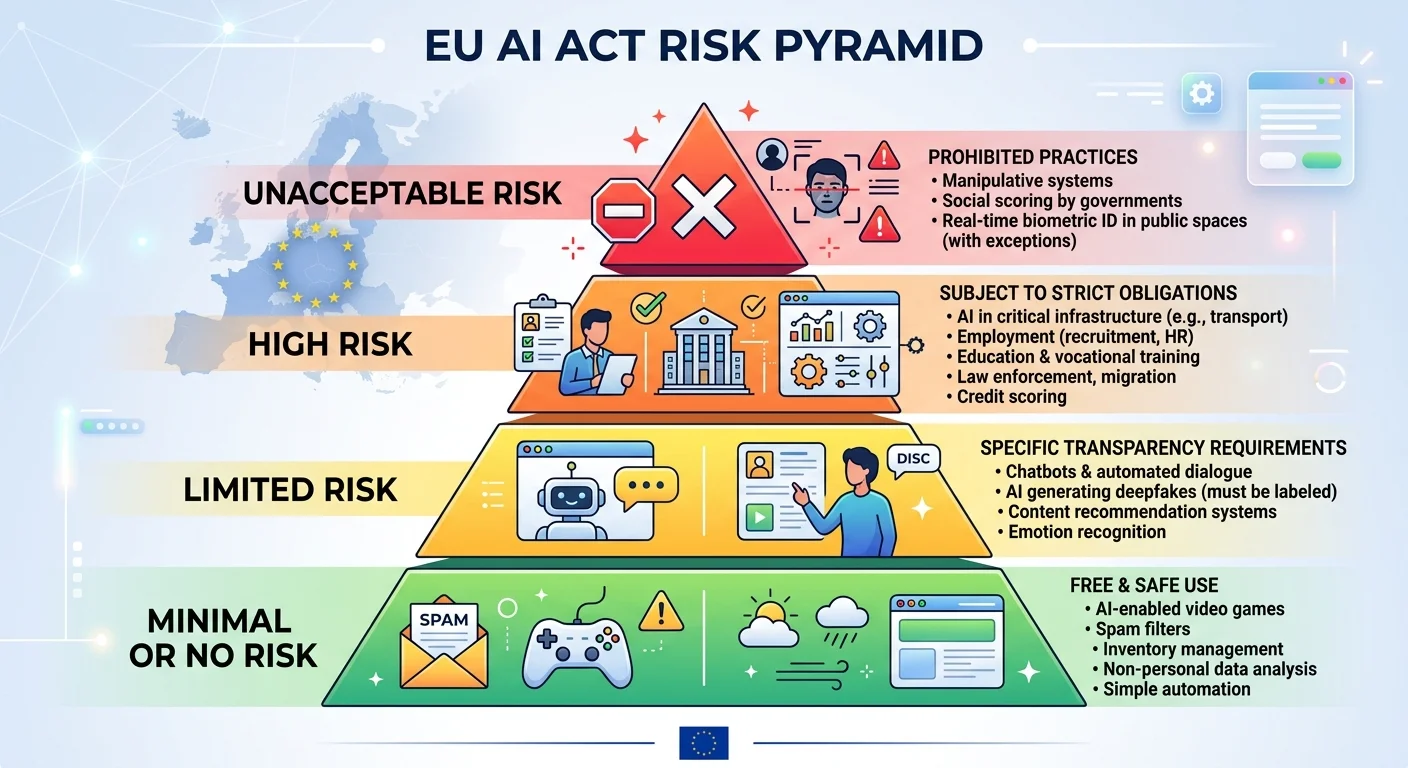
The entire EU AI Act is built around a risk-based approach. Rather than applying the same rules to every AI system, the regulation assigns obligations based on how much potential harm a system can cause. This means your first practical step is mapping every AI system your organization uses or develops to one of four risk categories. Getting this classification wrong has direct consequences: you might over-invest in compliance for a low-risk tool or, worse, miss mandatory requirements for a high-risk system entirely.
The Four Risk Tiers
The four tiers are unacceptable risk (banned outright), high risk (heavy regulatory obligations), limited risk (transparency requirements), and minimal risk (largely unregulated). High-risk systems include AI used in critical infrastructure, education, employment, law enforcement, and migration management. Limited-risk systems, such as AI chatbots, must disclose to users that they are interacting with AI. Minimal-risk systems, like spam filters or AI in video games, face no specific obligations under the Act.
Your organization likely operates across multiple tiers simultaneously. An HR department using AI for resume screening faces high-risk obligations, while your customer service chatbot falls under limited risk. Conduct a full inventory of AI systems across departments, and classify each one against Annex III of the EU AI Act, which lists specific high-risk use cases. This inventory becomes the foundation for every subsequent compliance action.
| Risk Tier | Example Use Cases | Key Obligations | Deadline |
|---|---|---|---|
| Unacceptable | Social scoring, manipulative AI | Complete prohibition | Feb 2025 |
| High Risk | HR screening, credit scoring, medical devices | Conformity assessment, risk management, human oversight | Aug 2026 |
| Limited Risk | Chatbots, emotion recognition, deepfakes | Transparency and disclosure to users | Aug 2026 |
| Minimal Risk | Spam filters, AI-enabled games | No specific obligations (voluntary codes) | N/A |
Create a centralized AI register that logs every AI system, its risk classification, responsible owner, and compliance status. Update it quarterly.
Step 2: Identify Prohibited AI Practices and Immediate Bans
The EU AI Act's prohibited practices provision is already enforceable. As of February 2, 2025, certain AI applications are outright banned in the EU. This isn't a future concern; it's a present legal reality. If any system in your portfolio falls into a prohibited category, you need to decommission it or fundamentally redesign it. The penalties for violations here are the steepest in the entire regulation: up to 35 million euros or 7% of global turnover.
What Counts as Prohibited
Prohibited practices include AI systems that deploy subliminal, manipulative, or deceptive techniques to distort behavior in ways that cause significant harm. Social scoring by public authorities, real-time remote biometric identification in public spaces (with narrow law enforcement exceptions), and AI that exploits vulnerabilities of specific groups based on age, disability, or socioeconomic status are all banned. Emotion recognition in workplaces and educational institutions also falls under the prohibition, as does untargeted scraping of facial images from the internet to build recognition databases.
Emotion recognition AI used in employee monitoring or school environments is already prohibited. Audit your vendor tools for this capability immediately.
Many organizations don't realize they may be indirectly using prohibited systems through third-party vendors. Your procurement process needs to include specific due diligence questions about AI capabilities embedded in software you license. Ask vendors directly whether their tools perform emotion inference, behavioral manipulation scoring, or biometric categorization. Document these assessments. Ignorance of a vendor's prohibited AI capability is not a defense under the regulation, and joint liability provisions mean both providers and deployers can face enforcement.
Conduct a targeted audit focused specifically on prohibited use cases. Interview department heads, review vendor contracts, and examine AI-powered features in your technology stack. Your legal team should cross-reference every AI-enabled tool against Article 5 of the EU AI Act. Where you find gray areas, consult the European AI Office's published guidance or engage external counsel with AI regulations expertise. Acting quickly on prohibited practices is non-negotiable because the enforcement window is already open.
"Ignorance of a vendor's prohibited AI capability is not a defense under the regulation."
Step 3: Meet High-Risk AI System Requirements
High-risk AI systems bear the heaviest compliance burden under the Act, and for good reason. These are systems that directly affect people's rights, safety, and livelihoods. If your risk classification exercise from Step 1 identified high-risk systems, this is where you'll spend most of your compliance effort. The requirements are detailed, prescriptive, and designed to produce auditable evidence that your systems operate safely and fairly.
Conformity Assessments and Documentation
Every high-risk AI system must undergo a conformity assessment before it can be placed on the EU market. For most systems, this is a self-assessment based on harmonized standards, though some biometric systems require third-party auditing by a notified body. You must produce extensive technical documentation covering the system's intended purpose, training data, model architecture, performance metrics, and known limitations. This documentation isn't a one-time filing; it must be kept current throughout the system's lifecycle. Conducting a thorough AI risk assessment under the EU AI Act framework is a practical starting point for building this documentation.
Risk management for high-risk systems must be a continuous, iterative process, not a checkbox exercise. Article 9 requires a risk management system that identifies foreseeable risks, estimates their likelihood and severity, adopts mitigation measures, and tests residual risk against acceptable thresholds. You need to define what "acceptable" means for your context, document your reasoning, and be prepared to defend those thresholds to regulators. Testing must cover performance under expected conditions, edge cases, and potential misuse scenarios.
Ongoing Monitoring Obligations
High-risk AI systems require post-market monitoring throughout their operational life. This means logging system outputs, tracking performance drift, and maintaining mechanisms for human oversight. The human oversight requirement is specific: qualified personnel must be able to understand the system's capabilities and limitations, correctly interpret its outputs, and override or shut down the system when needed. You cannot automate away the human element for high-risk AI. Training your staff to fulfill this oversight role is a tangible deliverable in your compliance plan.
Deployers of high-risk AI (not just providers) have independent obligations, including conducting fundamental rights impact assessments for public-sector use.
Step 4: Build Your AI Governance Structure for Compliance
Understanding rules is meaningless without the organizational structure to implement them. AI governance isn't a single person's job; it requires cross-functional coordination between legal, engineering, product, procurement, and executive leadership. The EU AI Act explained at a structural level demands that you embed compliance into how AI systems are designed, tested, deployed, and monitored. Treating compliance as an afterthought or a legal department problem will leave gaps that regulators will find.
Internal Processes and Roles
Designate an AI compliance officer or team with clear authority and budget. This role should own the AI system register, coordinate risk assessments, manage documentation, and serve as the liaison with national competent authorities. Establish an internal AI review board that evaluates new AI projects against regulatory requirements before development begins. This board should include technical, legal, and ethical perspectives. The goal is to catch compliance issues at the design stage, where changes are cheap, rather than at deployment, where they're expensive and disruptive.
Build compliance checkpoints into your AI development lifecycle at design review, pre-training, pre-deployment, and post-launch stages.
Your AI governance framework should include standardized templates for impact assessments, risk registers, and technical documentation. Don't reinvent these for every project. Create organizational playbooks that teams can follow, reducing both the compliance burden and the risk of inconsistency. Staff training is equally important. Engineers need to understand what documentation regulators expect. Product managers need to know which use cases trigger high-risk classification. Everyone involved in AI projects needs baseline literacy on the EU AI Act's requirements.
Timeline and Prioritization
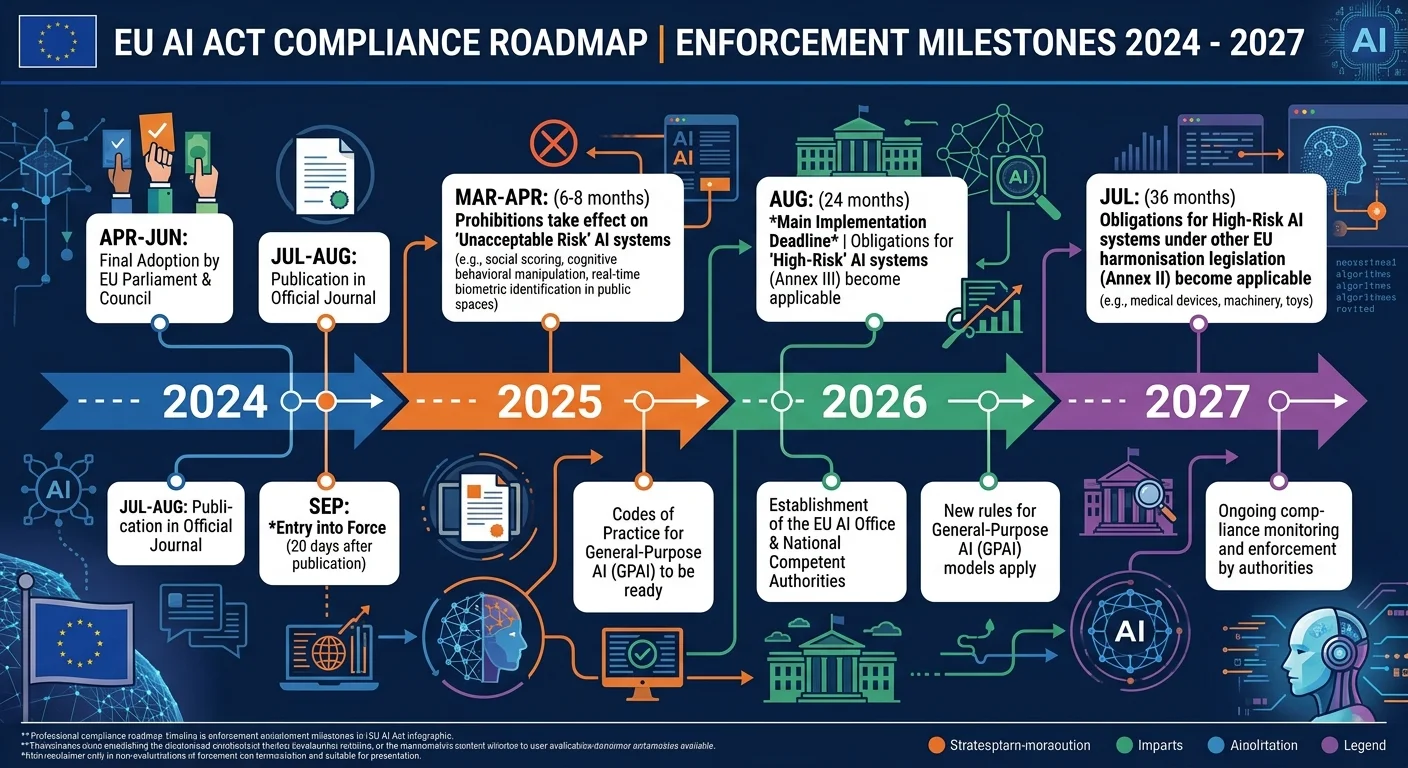
The EU AI Act's phased enforcement means you should prioritize based on deadlines. Prohibited practices are already enforceable. General-purpose AI model obligations (transparency, technical documentation, copyright compliance) apply from August 2, 2025. High-risk system requirements take full effect on August 2, 2026, with some legacy systems in regulated sectors (medical devices, aviation, automotive) given until August 2027. Map your specific AI systems against these dates and work backward to set internal milestones.
The EU AI Act explained in terms of resource planning means budgeting for legal advisory, technical audits, staff training, and potentially new tooling for monitoring and documentation. Organizations that treat this as a one-time project will fall behind. The regulation requires ongoing compliance, and national authorities across EU member states will develop their own enforcement priorities over time. Building adaptive governance now positions your organization to handle not just the current requirements but future regulatory guidance and amendments that will inevitably follow.
Frequently Asked Questions
?How do I start a compliance gap analysis for the EU AI Act?
?Does the EU AI Act apply if my company isn't headquartered in the EU?
?How long does meeting high-risk AI conformity assessment requirements take?
?Is it a mistake to assume most AI tools automatically fall under minimal risk?
Final Thoughts
The EU AI Act explained through these four steps gives you a concrete path forward: classify your systems, eliminate prohibited practices, address high-risk obligations, and build lasting governance structures. This regulation rewards preparation and punishes delay. The organizations that start now, even imperfectly, will have a meaningful advantage over those waiting for final guidance on every detail.
Compliance is a process, not a destination, and the smartest move you can make today is to begin mapping your AI portfolio against these requirements and assigning clear ownership for each action item.
Disclaimer: Portions of this content may have been generated using AI tools to enhance clarity and brevity. While reviewed by a human, independent verification is encouraged.